
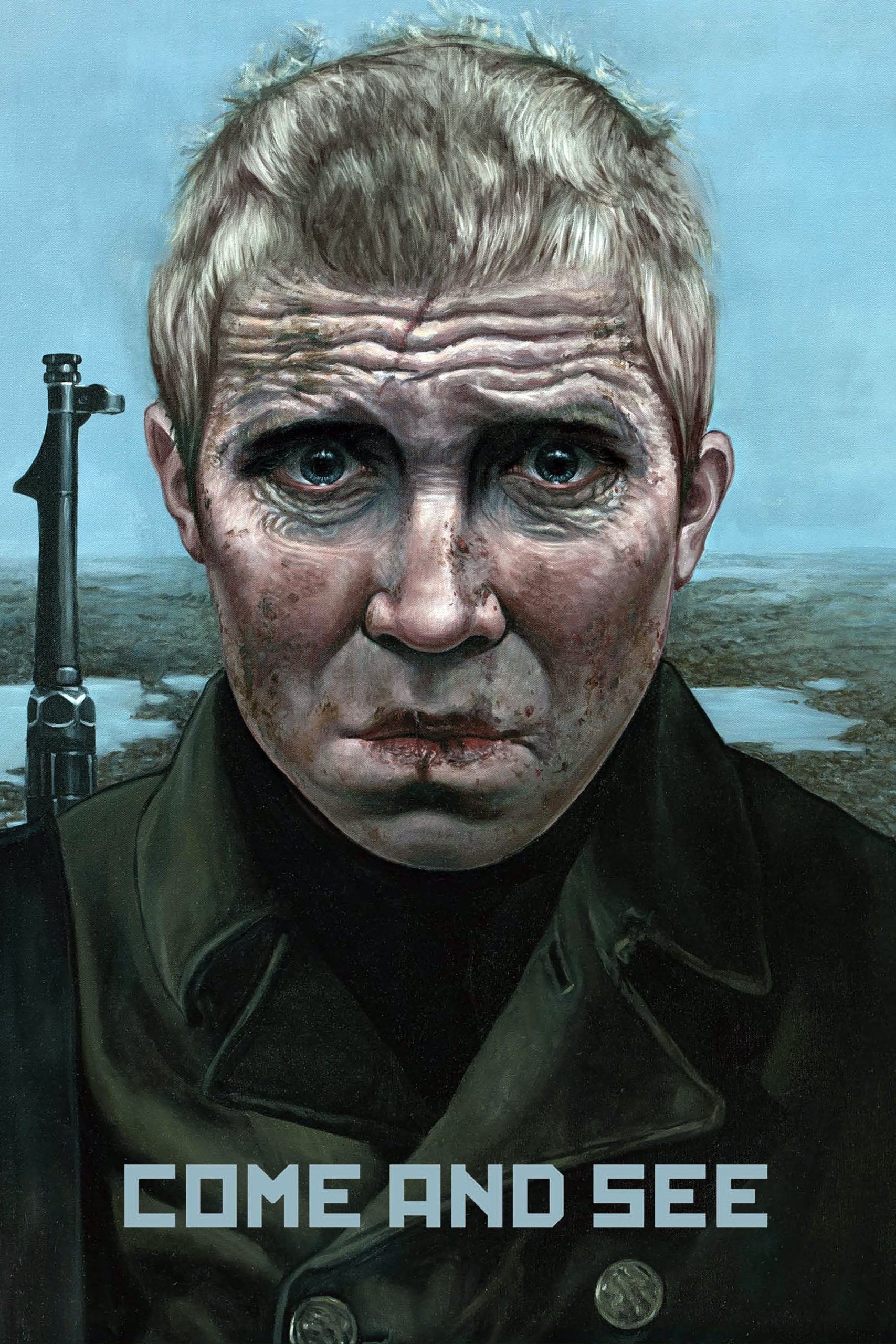
The Question of Truth Behind the Film
Come and See unsettled me from its earliest moments, not merely by the horrors it depicted, but through the persistent question that hovered over each scene: how much of this really happened? Whenever I sit down with a film that proclaims or even whispers about “true events,” I find myself automatically putting on a different set of glasses—ones that are sharper, but also heavier. I’m not alone in doing this. Many viewers, like me, want to know if the fear in a character’s eyes or a village’s destruction is a precise echo of reality or an invention for dramatic impact. There’s an implicit trust, or perhaps hope, that a story built on fact carries an extra gravity or significance. For some, the “based on a true story” label acts almost as a validation, lending weight to scenes that might otherwise feel too extreme. But I’ve noticed this tag also comes with assumptions: that what is shown is not only inspired by truth but is, on some level, representative or definitive. Personally, I sense the urge people have for certainty as they confront atrocities on screen—if this happened, then so much the worse, and so much more urgent is our engagement. Yet I’m always aware of how slippery this label can be, how it both attracts attention and reshapes the act of watching into a hunt for the boundary line between history and invention. Especially with a film as raw as Come and See, I find myself asking: am I witnessing history, storytelling, or some uneasy fusion of both?
Historical Facts and Cinematic Interpretation
My understanding of Come and See, as I dove into its genesis, transformed from passive viewing into a continual dialogue with historical record and artistic retelling. The film draws directly from documented Nazi atrocities in Belarus during World War II, and knowing this made me scrutinize every event for correspondence to what I have read in history books. Yet, as I watched, I found myself reflecting on how the real-life depredations of the Nazi occupation had to be compressed and reframed for a coherent film narrative. Individual survivor testimonies are fragmented; villages were burned, lives were shattered, but such crimes rarely unfolded with the narrative tidiness a film requires. The screenwriters behind Come and See gathered a mosaic of these voices, fusing and distilling them into the crucible of one protagonist’s journey. I realized how the experiences of thousands are distilled into Florya’s eyes and his shifting expressions—an artistic necessity to make the unspeakable more approachable, if no less horrifying.
For me, cinematic interpretation is not about altering truth, but about seeking a way to honor its complexity within limited time and storytelling structure. I noticed, for instance, that the film’s events collapse time: what happened over months is suggested to be occurring over mere days. The images that seared themselves into my memory, like the barn burning scene, are direct references to documented massacres, yet their specificity is a blend of actual incidents and creative assembly. I sensed that some details were heightened or constructed—dialogue, character interactions, even the surreal sound design—to push the viewer into a more visceral understanding. I cannot help but marvel at how cinema picks and arranges fact, not to falsify, but to awaken. In this sense, Come and See feels like a tapestry, woven from threads of hard historical record and interpretive imagination—a hybrid that transcends both simple documentary and pure fiction.
What Changes When Reality Is Shaped for Cinema
What fascinates me most about films like Come and See is how the process of adaptation both clarifies and distorts. Compressing reality into a two-hour structure demands acts of selection that inevitably leave much outside the frame. As I reflect on this, I am not lamenting loss or celebrating efficiency; I am observing the transformation that occurs. For me, narrative focus—choosing to see this war through one boy’s experiences—draws intense intimacy but also risks over-personalization. I become acutely aware that in order to construct a clear emotional arc, details must be streamlined. Events are arranged to provide momentum, suspense, and resolution (however bleak), qualities seldom found in the chaos of real history.
Watching Come and See, I notice that some moments are constructed to evoke not just memory, but response. The soundscape, the hallucinatory visual transitions, and even elements of coincidence within the plot are all creative interjections designed to translate historical suffering into experiential filmmaking. I recognize that these techniques can blur the boundaries between recreation and invention: is the protagonist’s breakdown an echo of a real survivor’s trauma, or is it a synthesis drawn from many such stories, intensified for the audience’s understanding? Practical trade-offs dominate here. Cinema demands symbols—a burned barn, a child’s toy in the ruins—that can bear emotional weight. Yet these symbols derive significance precisely because they are chosen, not because they are found in every testimony. To me, the negotiation between what was and what could be shown is not just technical, but philosophical. The film never claims to present a comprehensive chronicle; rather, it aspires to evoke the extreme states produced by real-world violence, filtered through the lens of narrative construction.
Audience Expectations and the “True Story” Label
Whenever I watch a film touted as grounded in reality, I catch myself watching closely for signs of authenticity—dialect, clothing, landscape, historical markers. There’s a heightened attentiveness, a hunger for accuracy, perhaps because I sense that reality might be stranger or crueller than fiction allows. Yet, with Come and See, I found my expectations stretching between two poles. On one hand, knowing the film’s basis in real testimonies made every event feel charged with the gravity of collective trauma. The claim to authenticity intensified my reaction: suffering depicted here was not only possible but (in some measure) actual. On the other hand, I wrestled with the knowledge that artistic mediation was at work. I do not expect literal documentary truth—actors are present, scenes are staged, scripted lines replace the spontaneous. For me, the film’s occasional hallucinatory tone and visual stylization foreground this gap, reminding me that re-creation is never simply reportage, but a project of meaning-making.
I’ve also noticed that audiences, myself included, often approach such films with paradoxical expectations. The more explicit the claim to truth, the more some viewers seek to fact-check details or decry perceived exaggerations. Others, perhaps overwhelmed by the horror, rely on the historical foundation as a way to process what might otherwise be unbearable. In this sense, the “true story” label becomes a double-edged sword: it shields the film from accusations of sensationalism, yet opens it to constant scrutiny about what is real and what is not. When confronted with scenes of devastation or brief moments of grace, I ask: is this documentary realism, or narrative necessity? I do not see these expectations as obstacles, but as part of the viewing experience—inflecting every moment with questions, doubts, and a desire to understand whether art is amplifying or reflecting reality.
Final Perspective on Fact vs Fiction
Sitting with my thoughts after Come and See, I recognize that knowing the film’s factual origins cannot help but alter my experience of it. The knowledge acts as a prism, refracting everything that unfolds on screen. When I am aware that a film’s terrors and devastations are not wholly invented, the sense of historical responsibility settles heavier on my shoulders. My engagement is no longer just about empathy for characters, but extends outward—to history, to collective memory, to the world that produced such stories. Yet, I cannot deny that the film’s interpretive choices—the shaping of experience into scenes, the bending of time and space, the creative abrasions added to brute facts—frame my understanding as much as any historical record might. I hold both realities in my mind: that this is a vision rooted in truth, refracted through artistry.
Personally, I don’t see the need to privilege pure fact over narrative interpretation, nor to dismiss lived experience for the sake of dramatic composition. My sense is that knowing what is “real” or “fictional” never simply resolves into reassurance or skepticism; instead, it calls me to read more attentively. The “true story” behind Come and See becomes, for me, a challenge—an invitation to look for resonance rather than literal correspondence. In the end, what shapes my understanding most is not merely a checklist of historical citations or deviations, but the balance the film strikes between honoring suffering and making it communicable through art. Fact and fiction exist here not as opposing forces, but as mutually sustaining elements. For each viewer, as for me, the weight of history is guided and reframed through cinema’s peculiar alchemy: selective, interpretive, but always reaching for some form of truth that cannot be reduced to fact alone.
For additional context, you may also explore the film’s overview and how it was received by audiences and critics.
🎬 Check out today's best-selling movies on Amazon!
View Deals on Amazon