
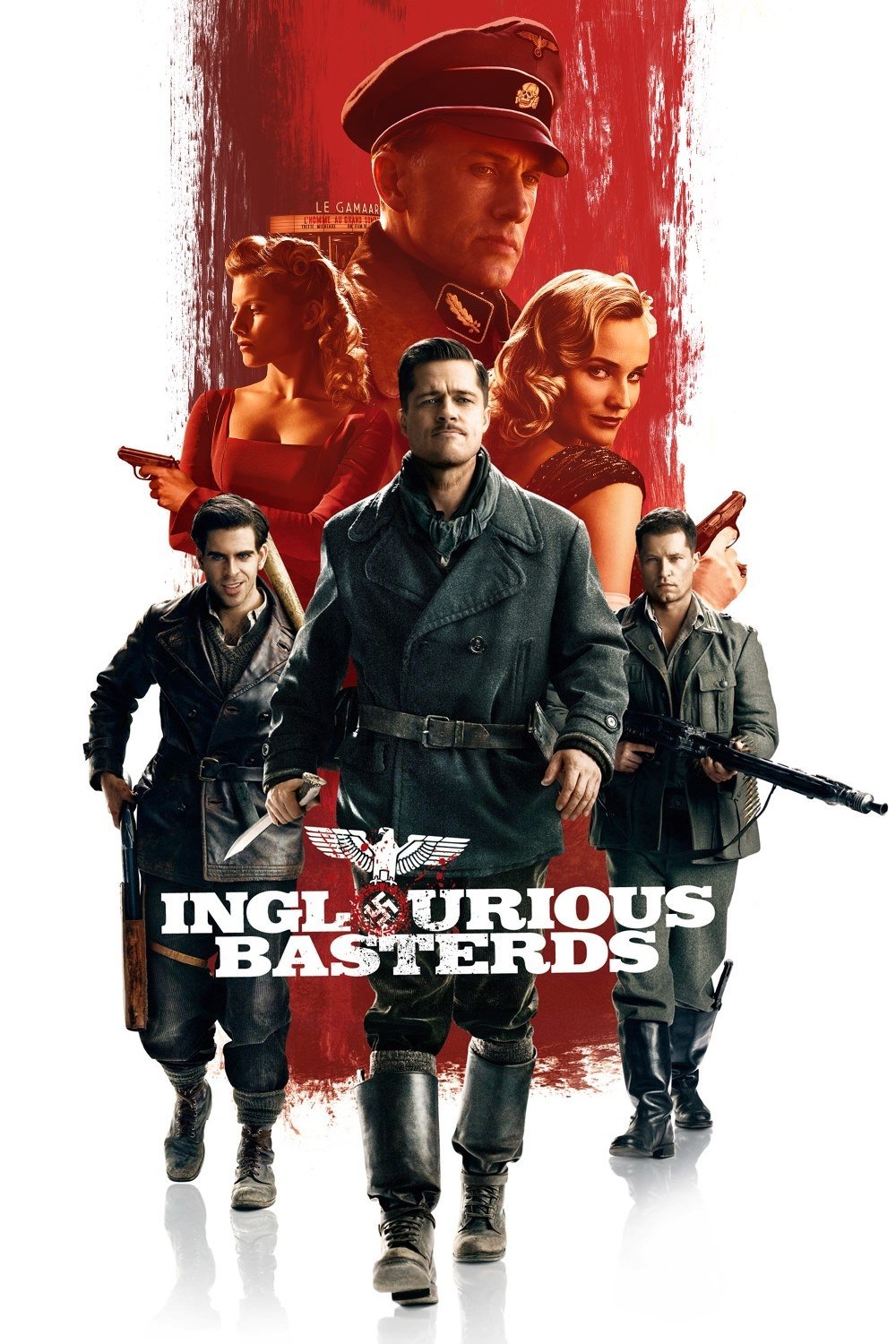
The Question of Truth Behind the Film
The first time I encountered “Inglourious Basterds,” I was struck not merely by its audacious characters or bloody spectacle but by the complexity of its relationship with historical fact. Watching the film, I found myself regularly asking: could any of this have actually happened? This knee-jerk curiosity about a film’s link with true events is almost automatic in me, often intensifying when the story ventures into significant historical periods like World War II. It seems as though whenever a film treats such monumental events, I arrive ready to measure its narrative against the yardstick of reality. Perhaps it’s because I associate World War II with a particular gravity—there’s almost an unspoken cultural contract that stories set in that era ought to mirror, at least in part, the experiences and suffering of real people.
When a film is branded as “based on a true story” or “inspired by true events,” my expectations shift dramatically. I anticipate a degree of reverence for source material, as if the filmmakers owe an implicit debt to history’s witnesses. This assumption isn’t always warranted, of course, but the label primes me to search for authenticity in the details: costumes, accents, military procedures, even the emotional tone. I start to scrutinize not only what is shown, but also what is omitted or exaggerated. If it lacks the “true story” marker, I tend to relinquish that scrutiny, allowing myself to be carried along by the current of fiction unburdened by a need for accuracy. “Inglourious Basterds” toes an odd line between the two, and my perception of its outlandish premises only sharpened when comparing it to the weight of actual wartime history.
Historical Facts and Cinematic Interpretation
I remember reading about how certain films rooted in history will compress timelines, merge personalities, or invent events within a recognizable framework in pursuit of drama. With this film, I immediately sensed that history was being both referenced and radically re-imagined rather than gently adapted. The basic premise—an elite group of Jewish-American soldiers undertaking an assassination campaign against Nazis, and ultimately plotting to topple Hitler himself—stands as a monumental divergence from the accepted historical record. In reality, no military unit like the Basterds ever operated in Nazi-occupied France, and the intricate, cinema-explosive plot to destroy the Nazi high command at a movie premiere is pure invention.
Reflecting on those choices, I see a pattern: real historical touchpoints anchor the movie’s world. There are authentic geopolitical tensions, generalized attitudes from both the Allied and Axis sides, and even real-life mechanisms of German occupation that feel plausible. But the moment characters step beyond those boundaries—when Hitler is gunned down in an inferno of bullets and fire inside a Parisian cinema—I recognize these are not so much fabrications as conscious revisions. Because these events are so far removed from the factual demise of Hitler in his Berlin bunker, I understand them as deliberate, almost operatic reinventions. This makes the film feel like an alternate history, a kind of mosaic built from period detail and pure imagination interwoven.
The existence of revenge plots and resistance sabotage groups is documented across occupied Europe, but upon examining the particulars of the Basterds’ campaign, I see them as a composite, inspired perhaps by stories of actual partisans, but mapped into a narrative territory that never bordered on reality. The inclusion of historical figures, from Adolf Hitler and Joseph Goebbels to Winston Churchill and various Nazi officers, reminds me that the film borrows the surface textures of the era. Yet, I’m always aware that characterization, dialogue, and fate are all filtered through a distinctly cinematic lens whereby every event serves the director’s dramatic outline more than any accurate chronicle.
What Changes When Reality Is Shaped for Cinema
One aspect I find endlessly fascinating when watching a film like “Inglourious Basterds” is how historical precision is continuously negotiated in favor of storytelling demands. I notice that this negotiation is rarely symmetrical; the scales usually tip heavily toward the pursuit of spectacle, catharsis, or symbolic meaning. For me, the choice to rewrite the most defining moment of twentieth-century Europe—the downfall of the Nazi regime—inside a crowded movie theater is a trade-off. On one side, actual history provides boundaries and constraints, ensuring that the magnitude of real suffering and heroism isn’t diluted. On the other, the cinematic approach unbuckles those restraints and forges a space where fantasy and wish-fulfillment eclipse hard truth.
The practical implications of this creative decision-making are palpable. I see that by letting go of the obligation to stick to historical chronology or causal realism, the filmmakers are free to focus on the narrative’s emotional truth or symbolic charge. Dialogue can be sharper, stakes artificially higher, and morality reframed into clear lines of vengeance and justice. The structure of the film takes precedence over documentary fidelity; five acts unfold like serialized fables, with each chapter distilling and exaggerating aspects of cultural memory or cinematic tradition. I find this particularly apparent when the Basterds deploy mythic violence the likes of which real partisans never did. The violence becomes a rhetorical device—less an attempt at imparting real history, more a commentary on what an audience might wish had occurred.
But there’s always something sacrificed along the way. In pursuit of clarity, I find that groups with heterogeneous backgrounds and strategies—such as the patchwork resistance networks operating throughout Europe—are distilled into a singular, iconoclastic group like the Basterds. Their methods aren’t just direct; they’re theatrical. Historical ambiguity, uncertainty, and the slow grind of war are traded for bravado and the immediacy of cinematic retribution. Characters like Hans Landa breathe with the air of pure invention—even if certain personality traits or attitudes are reminiscent of figures known to historians, their conversations and fate are constructed with the tension and rhythm that only fiction can provide. For me, the pressing urge to synthesize centuries of context into a story that can be told in under three hours is both an act of condensation and transformation, yielding a film that thrives on exaggeration while still pretending to wear the clothes of history.
Audience Expectations and the “True Story” Label
Every time I walk into a film “based on a true story,” I bring with me a different set of expectations than when the same film is pitched as a work of pure fiction. With “Inglourious Basterds,” there’s no opening text to declare its fidelity to real events—no date, no on-screen assertion—so I’m not immediately pressed to fact-check or anchor my emotional investment in what really happened. Instead, I find myself more attentive to the ways the film interacts with the broader myths we’ve built around World War II. Still, the appearance of recognizable names, places, and uniforms dredges up the assumption that I’m being asked to invest in a version of the past. The “true story” framework would have put me on guard for errors, but in its absence, I’m granted permission to interpret the film as a counterfactual tale—something between folklore and modern-day mythmaking.
When I watch a film that is explicitly presented as historical fact, I tend to scrutinize the details obsessively. If there’s a medal on the wrong lapel or a famous figure uttering words that don’t match their biography, I pick up on such choices and feel briefly pulled out of the film’s reality. I sense I’m being invited to learn or witness an interpretation of truth. When, instead, I realize that “Inglourious Basterds” revels in its artificiality—right down to its winking title misspelling—I can approach it as a kind of playhouse, where established history is only a set piece, not an endpoint.
At the same time, the line between fiction and reality is rarely absolute. In conversations after the screening, I’ve noticed that some audiences—even those fully aware that this version of Hitler’s demise is contrived—find themselves reflecting on what these alternative scenarios say about desire, revenge, and the ethics of storytelling. The heightened violence and retributive fantasy prompt questions not about what happened, but about what audiences wish could have happened. The blurring of fact and fantasy affects me too, prompting second thoughts about memory, myth, and how narratives about the past are shaped as much by what we long to be true as by documented evidence. If the film had followed strict historical lines, my engagement would likely be more cerebral—an exercise in comparing the film’s depiction to documentary records. As it stands, I’m free to treat it as an artifact of cultural imagination rather than a strict ledger of events.
Final Perspective on Fact vs Fiction
My lasting impression of “Inglourious Basterds” is colored by my awareness of just how far it diverges from its real-world setting. Knowing that its key events are imaginary gives me a framework for appreciating its bolder gestures—its screenplay, tone, and climactic moments—not as failed history, but as provocative thought experiments. That distinction directly shapes the way I interpret the film. Instead of viewing it as a reflection or record of events, I see it as a deliberate construction meant to interrogate, challenge, and even subvert the conventions of both traditional history-telling and popular cinema.
The more I reflect on the film’s approach, the more I realize that my understanding grows more nuanced as I oscillate between its factual inspirations and imaginative departures. I’m not asked to suspend disbelief for the sake of historical accuracy; rather, I’m invited to explore the intersection between narrative freedom and real lived experience. The film is littered with echoes of actual history—gestures toward real atrocity, resistance, and complicity—but filtered through a lens that prioritizes thematic impact over factual replication. My awareness of this balance, or deliberate imbalance, enriches my perspective, giving me license to appreciate the movie as commentary, illusion, and speculative narrative all at once.
This interplay between the real and the invented shapes the emotional ground I stand on as a viewer. When I recognize that the film’s treatment of Nazism, heroism, and vindication is not beholden to the limits of real outcomes, I understand that it serves a different purpose—provoking discussion, challenging expectations, and illustrating, perhaps, what cinema itself can accomplish when freed from the constraints of strictly factual storytelling. My engagement is therefore driven by layers of understanding—historical knowledge adds depth, while the creative departures stimulate imagination and critique.
Ultimately, I find that knowing what is and isn’t real in “Inglourious Basterds” does not lessen the film’s resonance, but rather frames it in such a way that meaning arises from the differences themselves. It reminds me that stories wield power whether or not they align with reality, and that the act of transforming fact into fiction can itself be a vehicle for new ideas. Far from undermining my viewing experience, the duality of fact and creative fabrication deepens it—encouraging me to consider not simply what happened, but what stories are for, and what we seek from them as audiences navigating the porous boundary between memory and imagination.
For additional context, you may also explore the film’s overview and how it was received by audiences and critics.
🎬 Check out today's best-selling movies on Amazon!
View Deals on Amazon