
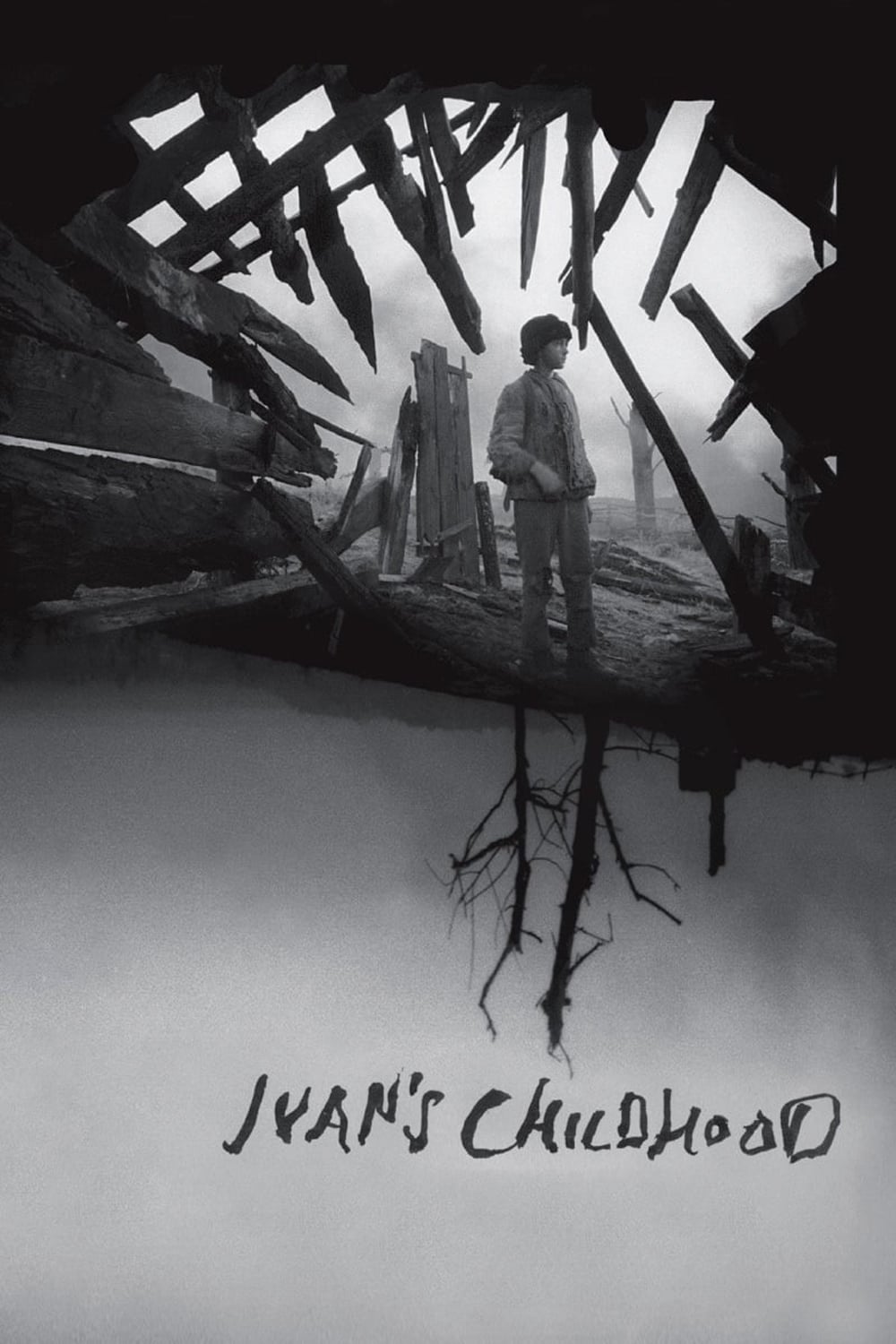
The Question of Truth Behind the Film
When I first encountered Ivan’s Childhood, what caught my imagination wasn’t just its stark imagery or even the harrowing experience of its young protagonist, but the persistent undercurrent of uncertainty about how much of what I was watching really happened. I’ve noticed that whenever I sit down with a film that bears the weight of war, especially one rendered as poetically as this, the desire to sort out what is real from what is invented becomes almost reflexive. Maybe it’s because, as a viewer, I carry a fascination with the lived experience of history. If a work says, “I am based on actual events,” I often approach each scene prepared to learn, to think of it as a kind of window into the past. There’s a certain trust in cinema that traffics in authenticity—viewers (myself included) lean forward, searching for evidence of truth, sometimes assuming that the label “true story” means that the emotions, outcomes, and even the atmosphere might faithfully reflect real-world occurrences.
When a film chooses to cite its historical grounding, I find myself questioning not only the fidelity of the events depicted but also the intentions beneath their staging. Is the director seeking to document or to dramatize? Does knowing what is recreated versus what is actual shape the kind of empathy I bring into the darkened theater? For me, the more I sense a film grappling with the layers between factual record and narrative artifice, the more I’m pressed to ask: am I absorbing history, or am I being invited to experience a crafted vision where truth is a raw material? These questions become urgent when watching works like Ivan’s Childhood, which take a searing, psychological approach to historical trauma. My expectations, I realize, are never neutral. If given the sense that a story “actually happened,” I often find my engagement shifting; I read faces for signs of survival, I measure details differently. The desire to distinguish between fact and invention isn’t just a matter of trivia—it’s about drawing the line where memory ends and storytelling begins.
Historical Facts and Cinematic Interpretation
When thinking over Ivan’s Childhood, I’m always struck by how the raw outline—its World War II setting, the figure of a boy conscripted by fate into espionage—inevitably raises questions about what is ripped from the annals of history versus what belongs to the realm of fiction. Although the film adapts Vladimir Bogomolov’s novella Ivan, I have to remind myself: the source itself is a fictionalized account, albeit one shaped by the writer’s familiarity with wartime realities. This means my experience as an audience member is already a few steps removed from documentary truth. Still, the film never feels divorced from “the real.” I sense that its visual language is endlessly attentive to the textures of rural Soviet landscapes during the war, or to the repercussive trauma that children might endure under such pressure.
Watching the movie, I can see how the realities of the Eastern Front have been filtered and distilled to suit the film’s sparser narrative structure. The events unfold not as a strict chronology, but as a poetic sequence, crossing from the war’s brutality to Ivan’s precarious interior world. The acts of adaptation here involve choosing what to show and what to omit: protracted battles are replaced by moments of psychological stillness, and the grand sweep of military campaigns narrows to focus on personal, often fragmentary, suffering. I’ve always been fascinated by how filmmakers like Tarkovsky condense wide-reaching historical catastrophes into selective, almost dreamlike vignettes. In this way, the larger story of the Soviet wartime experience gets winnowed down until it lives in a handful of gestures, glances, or half-remembered nightmares.
In terms of facts, the story’s skeleton—child partisans, ruined villages, the constant menace of betrayal—surely reflects a composite of actual occurrences drawn from a battered landscape. Yet, from my viewpoint, it’s clear that these real elements have been reorganized for a different purpose. Instead of following a single, uninterrupted biographical arc, the film is built of moments chosen less for documentary fidelity than for their cumulative psychic impact. Small details—a scorched barn, a flash of barbed wire, a haunting lullaby—convey truth not through literal accuracy, but through metaphorical resonance. I find myself acknowledging that, even when cinematic narrative borrows from reality, it rearranges and reframes those facts to suit aesthetic and emotional ends. This reshaping is not accidental, but built into the very grammar of film.
What Changes When Reality Is Shaped for Cinema
As I think over the forms historical truth takes when adapted into cinema, I keep returning to the tangible trade-offs that come with dramatization. For a film like Ivan’s Childhood, rooted in the echoes of an actual war but driven by stylized storytelling, the boundary between life and art is never static. I often find myself weighing the consequences of certain narrative choices: if a story tidies up the disorderly sprawl of events for the sake of coherence or resonance, what is gained and what is left behind? In my experience, filmmakers who grapple with history must choose between immersive, lived-in detail (potentially confusing or overwhelming) and distilled, emblematic moments that can register more potently, though sometimes at the expense of nuanced understanding.
Through my own study of Ivan’s Childhood, I encounter several key shifts: the compression of time, the simplification of complex social dynamics, the spotlighting of singular trauma as representative of a much broader suffering. The reality of war as documented in memoirs or firsthand accounts is usually sprawling and repetitive, marked by long stretches of waiting and incomprehensible terror. Here, those realities are transformed into tight, visually evocative narrative set-pieces—a risk-ridden crossing through a swamp, a memory of childhood joy shattered by violence, a moment of uncertain friendship at a soldier’s outpost. For me, this distilled focus makes the film’s emotional landscape accessible and gripping, but I’m always aware that it is exactly that: a landscape, mapped and ordered by screenwriters and directors.
A further example that resonates strongly for me is the use of dreams throughout the film. These sequences aren’t “factual” in the strict sense; they are cinematic inventions meant to communicate Ivan’s psychological state, to open a window into what the official record can’t access. This use of dream as narrative device feels to me both essential and transformative—where actual events might be lost to time, the film invents images, echoes, and patterns that allow audiences to feel the emotional truth of history, if not its documented specifics. I’m reminded that shaping reality for cinema is not about falsifying the past, but rather about translating it—making sense out of what might otherwise remain unspeakable or chaotic. Each shortcut, each conflation or symbolic decision, is a negotiation between the demands of storytelling and the obligations to represent the profundity of loss and resilience in war.
Audience Expectations and the “True Story” Label
Whenever I sit in on discussions about films like Ivan’s Childhood, I’m constantly aware of how the “true story” label colors viewer response. If I approach a film thinking it is directly adapted from real events, my critical faculties adjust accordingly. I’m likelier to scrutinize scenes for historical accuracy, and I tend to take the characters’ experiences as indicative of a wider reality. In the case of Ivan’s Childhood, the ambiguity of its origins—based on a fictional work but founded in historical atmosphere—creates a more complex web of expectations. As I watch, I can’t help but feel the tension between the urge to accept the film as a truthful witness and the awareness that I am, in fact, watching a work of creative interpretation.
When I discuss the film with friends or fellow viewers, I notice that many assume the child protagonist must be based on an actual figure from wartime Soviet history, even if this is not explicitly stated. This assumption can be powerful—it positions the story as universal, a kind of stand-in for countless young victims of war. I understand this impulse, and I sometimes share it: believing in the authenticity of Ivan’s journey may deepen the emotional resonance and the sense of historical tragedy that the film evokes. At the same time, knowing the boundaries of fiction allows me to recognize the artistic license at play. It affects how I measure the meaning of the film’s more poetic or surreal choices. If I believe those sequences are strictly documentary, I might read them as flawed realism; if I view them as dream logic, I see them as attempts to bridge the gap between what was and what is imagined.
I’ve also found that the context in which I first encounter a film shapes my acceptance of its historical claims. If I’m told in advance that the story is “inspired by” real events, I engage with it on dual terms: I allow myself to be moved by its narrative, while also holding space for the gaps and inventions inherent to the genre. Conversely, a film marketed explicitly as fiction gives me greater freedom to focus on its form, its mood, and its psychology, unburdened by the pressure to treat it as a reliable historical record. In the particular case of Ivan’s Childhood, this interplay is heightened by the ambiguity of source and adaptation; I find myself oscillating between seeing Ivan as a synecdoche for lost generations, and as a singular, invented persona created to explore the echoes of war.
This dynamic, for me, raises crucial questions about what audiences—myself included—really seek from “true” stories. Are we looking for catharsis? Recognition? An anchor in the fog of historical violence? When realism and invention interleave as they do here, I’m confronted by the fact that my own expectations are largely driven by how the film frames itself—a testimony, a memorial, a fever-dream. My response, I realize, is contingent on what I’m asked to believe and where I am invited to suspend disbelief. The “true story” designation, far from being a guarantee of authenticity, often sets the terms for how and why I invest emotionally and intellectually in what unfolds onscreen.
Final Perspective on Fact vs Fiction
After spending a great deal of time contemplating Ivan’s Childhood, what remains with me is a sense that the line between truth and fiction is less a border than a shifting, porous membrane. My appreciation for the film has deepened as I’ve learned to recognize its methods of reshaping historical trauma—neither as pure invention nor as rote recitation of events, but as a deliberate translation of experience into visual poetry. Knowing which elements are drawn from historical fact and which are conjured for narrative or stylistic effect doesn’t close down the film’s meaning for me; on the contrary, it complicates and expands it. I find myself reflecting on the purposes historical films might serve: not as museum pieces, but as living meditations, structured to provoke empathy, memory, and sometimes, uncertainty.
For me, the real value of distinguishing between what is real and what is made up lies not in settling accounts, but in sharpening my sensitivity as a viewer. When I recognize that a character is a construct, or that a sequence has been altered for emphasis, I can ask new questions: Why was this change made? What is this image or moment trying to communicate that bare fact could not? I’m no longer simply passively receiving someone else’s history, but am instead participating in its recreation, alive to the gaps and silences that fiction gives voice to. With Ivan’s Childhood, this stance lets me hold the film’s horrors and its lyricism in productive tension, valuing both what it tells me about the past and the unique ways it tells it.
In the end, my understanding of any historical film—including this one—rests on a spectrum: at one extreme, total docudrama, at the other, free invention. What Ivan’s Childhood has taught me is that the richest interpretive ground lies somewhere in between. Whether a detail is literally true or creatively imagined, my awareness of its origins shapes—not limits—my response. I find it liberating, even necessary, to accept that films about the past can never be fully disentangled from their own time of creation, nor from the ongoing needs of their audience to make sense of difficult histories. My engagement with this film has become an exercise in seeing not only what is present on the screen, but also the shadows of what might have been, or what was never recorded at all.
For additional context, you may also explore the film’s overview and how it was received by audiences and critics.
🎬 Check out today's best-selling movies on Amazon!
View Deals on Amazon