
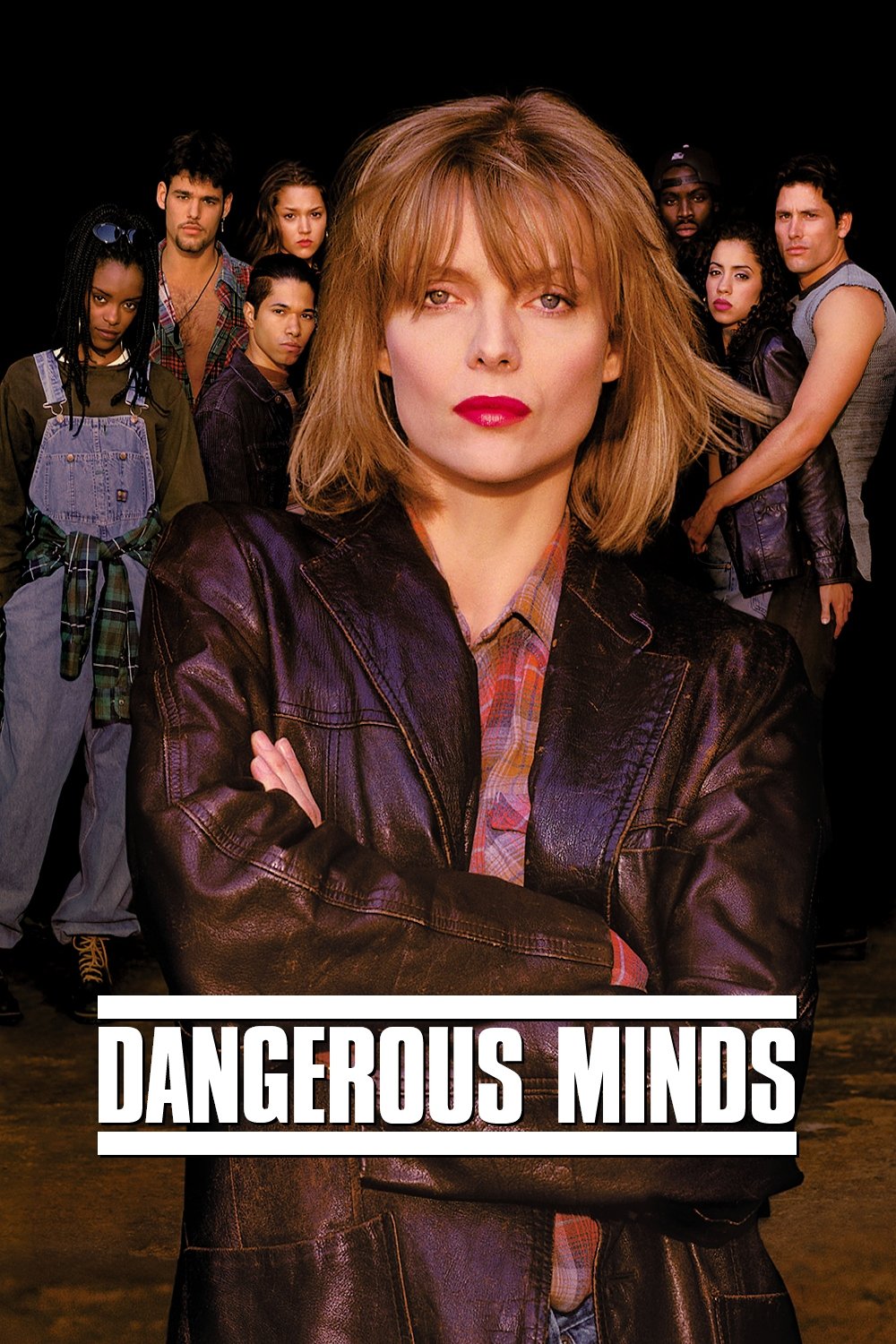
The Question of Truth Behind the Film
Sometimes, when I walk out of a movie theater after watching something like Dangerous Minds, I find myself haunted less by the images flickering on the screen and more by the question: “Did all that really happen?” There’s a peculiar pull audiences—including myself—feel toward the phrase “based on a true story.” I notice that when a film makes even a modest claim to real events, the experience of watching shifts; suddenly, the story isn’t just a drama constructed for our entertainment, but a representation of someone’s lived ordeal, triumph, or tragedy. The assumption behind these labels is profound: viewers, myself included, often presume that what is seen is, with some latitude, what was. There’s a desire to believe that the emotional stakes aren’t merely manufactured, but inherited from a reality that once existed. With Dangerous Minds, this underlying search for truth anchors the reception and any analysis that comes after, coloring everything from character motivation to audience empathy.
When I encounter films that involve claims of fact—no matter how qualified with words like “inspired by” or “adapted from”—I notice a subtle shift in how I relate to the narrative. Realism becomes a measuring stick, even if subconsciously, and the urge to parse fact from invention asserts itself. I think this tendency stems partly from a basic human curiosity: Did people really say these things? Did events unfold this way—dramatically, poignantly, or perhaps too neatly? Even before researching the production or consulting outside sources, my viewing is shaped by the knowledge that the story didn’t originate entirely from a writer’s imagination. In a sense, I become part detective, part witness, drawn to the gaps between history and retelling, always attuned to where embellishment might reside.
Historical Facts and Cinematic Interpretation
The real events that loosely support Dangerous Minds derive from LouAnne Johnson’s autobiography, My Posse Don’t Do Homework. Having read about the genesis of the movie, I’m struck by how the film’s portrait of a white, ex-Marine teacher in an urban classroom is not so much a transcription of Johnson’s actual experiences as it is a thematic arrangement of them. For all the talk of “truth,” the line between life and screen is almost always unstable, refracted through the demands of plot structure and character arc. In my own engagement with the movie, I recognize how the raw complexity of Johnson’s real-life teaching career—years of incremental change, frustrations, nuanced relationships—is elided in favor of episodes that advance the story swiftly and with clarity. Condensation of time and selective emphasis are not just common, but almost inevitable, when rendering memoir into screenplay.
As I trace the ways fact morphs into narrative, I’m reminded that the events depicted are not a documentary record. The students, for example, are presented as composites; their struggles streamlined in service of the film’s central theme. In my view, this process is as much about exclusion as it is about inclusion. Not every challenge or cultural detail from Johnson’s account survives in the adaptation. Instead, the filmmakers seem to select those incidents that most forcefully illustrate the friction between teacher and classroom, or that most efficiently rediscover hope in the face of apathy. From my perspective, this curation of reality both simplifies and amplifies: it brings clarity and immediacy to the story, but inevitably loses some of the complexity that real life contains in abundance. When I compare movie scenes to sections of the memoir, the inflection points are obvious—conversations reimagined, timelines condensed, outcomes often more resolute than any history could document.
What Changes When Reality Is Shaped for Cinema
I often find myself negotiating the compromises that arise when filmmakers translate messy, long-form experience into two tightly edited hours. The trade-offs become apparent as I notice the ways Dangerous Minds adapts Johnson’s memoir: subtleties of classroom culture, prolonged moments of failure, even some of the grittier or less palatable details, are altered to fit the demands of cohesion and audience engagement. In my view, the film must balance an array of needs—holding an audience’s attention, conveying a character’s transformation, and delivering thematic resolution—all within a narrow window. This imperative often means smoothing out the unpredictability or inefficiency that typifies actual lived experience.
Take, for instance, the film’s celebrated scenes of confrontation and change, moments where the classroom dynamic pivots on a single act of generosity or authority. My readings about Johnson’s real classroom suggest that personal growth and trust build—or unravel—over extended periods of trial and error. The film, by necessity, compresses these years into montages, sometimes centering pivotal lessons around a singular poem or incident (Dylan Dylan Thomas or Bob Dylan as a literary touchstone being one prominent example). To me, this isn’t a criticism but an observation: cinematic stories hunger for shape, for tension and release. By reordering, amalgamating, or heightening reality, filmmakers carve narrative arcs that satisfy conventional expectations. I see this as a process of negotiation: realism yields to rhythm, and the audience receives a story that’s emotionally legible but often less detailed in its historical rendering.
Another practical alteration that stands out to me is the focus on one heroically inclined teacher figure. The memoir, and indeed the true landscape of public education, is far more collective—filled with other faculty, support systems, failures, and competing forces. Yet the film orbits almost completely around the central figure, condensing structural inequalities and systemic issues into interactions with a few symbolic students. By directing narrative energy toward a handful of archetypally troubled teens, the film achieves dramatic propulsion, but it also sidesteps the more diffuse, often impersonal nature of educational challenges described in Johnson’s account. As a viewer, I am aware of these elisions—the trade of accuracy for engagement is rarely invisible to me, especially when I read about the source material or listen to interviews with those involved. What results is a hybrid: a story indebted to reality but meticulously designed to function as cinema.
Audience Expectations and the “True Story” Label
I’m always interested in how powerfully the label “based on a true story” shapes my own anticipation and response. When I know a film draws inspiration from real life, my focus extends beyond just plot. I look for clues—anachronisms, embellishments, or any sign that the dramatization diverges from what might have been. With Dangerous Minds, this expectation is heightened because the marketing and framing foreground its real-life origins. I find that this positioning primes me, as well as many other viewers, to approach the story with a readiness to empathize more deeply and, sometimes, to invest more hope or outrage in the outcomes depicted.
Yet I also notice a different dynamic emerges if a film declares itself to be simply “inspired by” real events, signaling a looser relationship to fact. In these instances, I am less likely to interrogate the details or judge characters by the standards of plausibility; I become more willing to accept poetic license. On the rare occasion when a film is presented without any claim to veracity—wholly fictional—I feel freed from any obligation to weigh accuracy and can immerse myself fully in metaphor or fantasy. For Dangerous Minds, however, the boundary between reality and invention is foregrounded. My engagement as a viewer is informed by a kind of contract: the promise that what I am watching is not just entertainment, but also an insight—or, at minimum, an interpretation—of actual events. This knowledge inevitably colors my emotional investment, making the story’s highs more inspiring and its lows more sobering, precisely because they purport to mirror what happened.
I’ve spoken with friends and colleagues who describe similar reactions—a disappointment or disillusionment if, after the film has made its mark, they discover key elements were fabricated or rearranged. Conversely, there is often a sense of validation, almost of being granted access to privileged knowledge, when confirmed as authentic. The label of “truth” carries a heightened expectation that the film will deliver not only entertainment but also education or insight into a world unfamiliar to many viewers. My own perspective is that this dual demand complicates the viewing process. I’m not simply assessing plot or performance, but also engaging in a subtle form of fact-checking, drawing on my awareness of how cinema tends to embellish, compress, or shift real experience. Each time I watch a film like Dangerous Minds, I can feel myself performing this dance between accepting the emotional force of the story and questioning its actual alignment with history.
Final Perspective on Fact vs Fiction
My lasting reflection on the interplay between fact and fiction in Dangerous Minds is one of heightened critical awareness rather than disillusionment. Knowing the boundaries of what is documented and what is dramatized dramatically alters my interpretation, without dictating my overall response. I find my engagement deepens as I sift through layers of adaptation—tracing what comes from Johnson’s memoir, what is reimagined, and what is entirely constructed for effect. In many ways, this heightened awareness doesn’t dilute the power of the narrative, but rather sharpens my understanding of its function. The film becomes a conversation—not just between teacher and student, or even audience and performance, but between real events and their reconfiguration into cinematic language.
For me, the awareness that key classroom incidents are reshaped or accelerated for storytelling purposes does not erase their resonance, but it does make me more attentive to the mechanics of adaptation. I become more conscious of deliberate choices: the selection of which real-life struggles to foreground, which to omit, and which to recast in more dramatic hues. This self-awareness enhances my ability to reflect critically on the story’s themes and societal implications, even as I acknowledge the limits of its literal accuracy.
Ultimately, I approach Dangerous Minds not as a faithful retelling of LouAnne Johnson’s career, but as a hybrid blend—anchored in fact, sculpted in fiction. This framing allows me to appreciate both the thrill of narrative invention and the backbone of real experience. The acknowledgment of these boundaries doesn’t diminish my emotional response or the film’s artistic ambitions. Rather, it sustains a more nuanced, layered perspective—one where the intersection of truth and storytelling becomes a lens through which I can interrogate both the world the film portrays and the medium’s broader possibilities.
For additional context, you may also explore the film’s overview and how it was received by audiences and critics.
🎬 Check out today's best-selling movies on Amazon!
View Deals on Amazon