
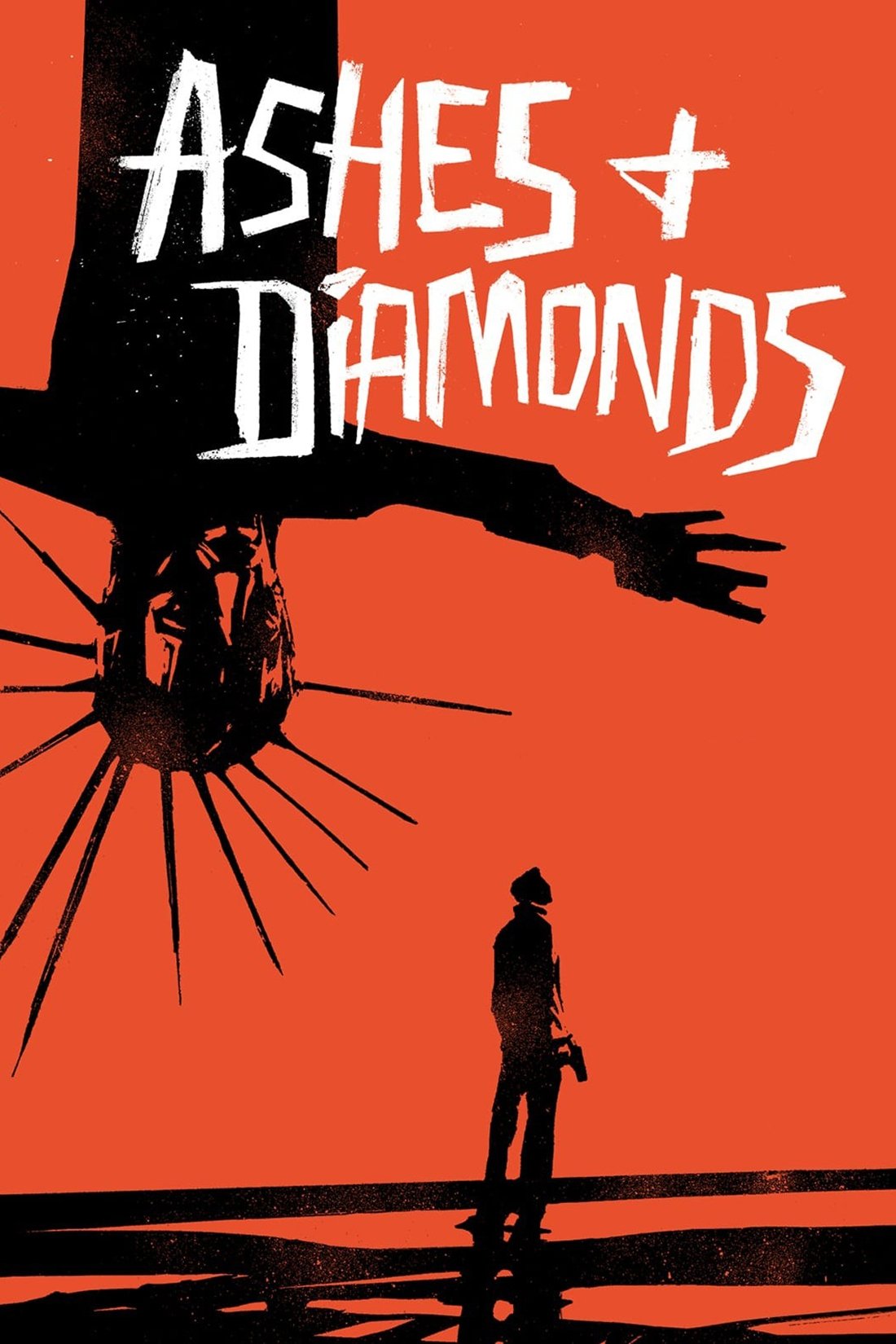
The Question of Truth Behind the Film
Before I even watched “Ashes and Diamonds” for the first time, I caught myself scanning the synopsis for any hints that what I was about to see might have actually happened. There’s something about films with historical settings that stirs this instinct in me—I want to know if these images and conflicts grew from real lives, actual moments forged in time. When a movie like this arrives marked by its proximity to history—sometimes through vague titles like “based on true events” or simply by its recognizable setting—I find myself unconsciously leaning in, searching for signposts of authenticity, wanting some guarantee that what I’m witnessing is more than just artful invention. I suspect I’m not alone in this compulsion, since many discussions I’ve had about films, especially those set amid upheaval or postwar disarray, begin and end with, “But did it really happen like that?” It’s as if the historical label is a tacit contract, a promise of educational value or moral gravitas, even if I know from experience that storytelling and factual accuracy are often strange bedfellows.
What intrigues me most is the assumption that absorbing a history-soaked film will bring me closer to the truth of an era. This expectation colors the viewing—if I know it’s “real,” my mind becomes a detective, parsing out details for meaning, looking for allegories and parallels to the world outside the screen. I’ve felt this keenly with “Ashes and Diamonds,” whose mood and symbolism seem engineered for scrutiny. Audiences like me arrive armed with two conflicting desires: to be entertained by the swell of drama, and to have our intuitions about history confirmed. This constant toggling between believing and questioning drives much of my reflective process long after the credits roll.
Historical Facts and Cinematic Interpretation
The period that frames “Ashes and Diamonds”—the last day of World War II in Poland—is a moment dense with historical weight for me, especially considering how charged the aftermath of the war remained in public memory and national discourse. As someone who turns to cinema as a lens for understanding unfamiliar histories, I pay careful attention to the mechanics of adaptation. In my view, what unfolds on screen is rarely a direct translation of real events. Instead, I recognize a process where lived experience gets filtered, magnified, and stylized to serve the demands of a filmic story.
When I consider the origins of “Ashes and Diamonds” I’m reminded that Andrzej Wajda’s film is rooted in Jerzy Andrzejewski’s novel, which itself is steeped in the confusion, moral ambiguity, and shifting power structures that defined 1945 Poland. The setting and backdrop—Polish resistance fighters, the presence of new Communist authorities, the palpable sense of national fragility—are drawn from the texture of real daily life as the old regime fell away. Yet, I see that the characters and their specific trajectories are composites. Maciek, the central figure, is not a historical person but rather an amalgamation—his experiences inspired by true collective memories, losses, and choices of countless Poles.
What I find fascinating in the film’s approach is not just how it compresses time (the story unfolding in a single night), but how it carefully selects what details to foreground and omit. As I watched, I caught how events that might have spanned months—or even years—in reality are distilled into a claustrophobic narrative arc. The broader chaos of the era, with its shifting alliances and complicated loyalties, becomes focused through the tight lens of one assassination attempt and its aftermath. This serves not just to heighten emotional intensity, but to dramatize the private conflicts and moral uncertainties that history books often flatten. I’m always struck by how these adaptive decisions—what to amplify, what to silence—fundamentally shape my own take on the period the film depicts.
What Changes When Reality Is Shaped for Cinema
For me, the gap between historical documentation and cinematic rendering is not a void to be deplored, but a living space where meaning gets constructed. Every adaptation I’ve examined, including “Ashes and Diamonds,” treads a delicate path between the demands of accurate representation and the imperatives of compelling drama. I notice that when reality is refashioned for the screen, the result is often a heightened, sometimes mythic presentation that lingers with me long after more “realistic” accounts have faded.
One of the clearest trade-offs I see is found in the way the film trims or embellishes chronology for emotional coherence. In practice, life unfolds erratically, messily. Cinema, on the other hand, calls for structural clarity. I recognize this in how “Ashes and Diamonds” telescopes the events of postwar Poland into a single charged day and night. The practical effect is that the viewer (myself included) can sense the intensity of being at a crossroads—every encounter feels fraught, every symbol (like the burning vodka glasses or the unmade bed) feels weighted with fate. Yet I’m also aware that this powerful sense of destiny is partly a construction, a dramatic necessity rather than a direct echo of lived experience.
Another aspect I keep returning to is the film’s selective use of setting and character. By zooming in on a handful of individuals—primarily Maciek and those trapped in his orbit—Wajda’s film forgoes the sweeping crowd scenes or larger social panoramas that a more documentary-style work might favor. This shapes my perspective: the complexities of nationwide transformation are rendered intimate, almost private. I know this creates access to universal emotions but also simplifies the tangled motivations and stakes of a population at large. It’s a tension I’ve had to reconcile, appreciating how specificity deepens my engagement while acknowledging what gets left outside the frame. As a student of history and cinema, I can’t help but notice how these micro-level decisions inform what I ultimately retain from the story.
Sometimes, what’s most illuminating to me is not what the film depicts, but what it elides. “Ashes and Diamonds” rarely lingers on everyday civilian responses or the broader international context; instead, it moves with a kind of single-mindedness through Maciek’s ordeal. On one hand, this focus distills the pervasive sense of alienation and the existential crises that defined many postwar societies. On the other, it means that vast swathes of historical experience—women’s lives, rural perspectives, ideological opponents—are only glanced at, usually through fleeting dialogue or background images. My own viewing becomes a process of piecing together the broader truth from carefully chosen fragments. The result, for me, is a richer emotional experience but one that leaves room for ongoing inquiry.
Audience Expectations and the “True Story” Label
My reaction to a “true story” credit has always been complicated—I know that it primes me and many other viewers to absorb the ensuing narrative with a different kind of seriousness. Sometimes I catch myself policing the screen for inaccuracies, or measuring the unfolding drama against what little historical knowledge I carry with me. With “Ashes and Diamonds,” whose reputation is anchored to the specificity of time and place, I felt myself toggling between acceptance and skepticism: was this really how things looked, sounded, and felt in that exhausted, feverish slice of 1945 Poland?
When the film doesn’t clearly state whether it presents fact, fiction, or “inspired by” material, I’m left to negotiate my own expectations. Part of me is liberated—I can appreciate the poetry or the symbolism without worrying about fidelity to actual events. But another part lingers over the details, wondering how much is representation, how much invention. I think many viewers experience this cognitive dissonance, wanting both the pleasures of storytelling and the authority of history.
For me, the “based on true events” tag doesn’t so much guarantee accuracy as it triggers a different mode of attention. I read images more closely, hunt for anomalies, and try to discern where the line between creation and confession lies. When I watch “Ashes and Diamonds” knowing its roots in a novel—already a form of mediated experience—I’m reminded of how mediated all history ultimately is. Every narrative, I realize, is a choice; facts are always arrayed, manipulated, even when the intent is truthfulness. Yet, the pleasure of discovery remains strong. In moments where I can match on-screen gestures to documented historical conditions—whether it’s the visible exhaustion of the characters or the omnipresent sense of rupture—I feel the satisfaction that comes from verification.
Watching a historically informed fiction like this also leaves me questioning how much I seek reassurance or alignment in my own beliefs. I’ve noticed that when a film dramatizes something I already know or suspect, I’m more likely to take its meaning at face value. Conversely, where it diverges from accepted fact or introduces alternative perspectives, I feel a flicker of resistance or curiosity. My relationship to the “true story” label, then, is always evolving, shaped by what I bring to the film as much as by what the film brings to me.
Final Perspective on Fact vs Fiction
The more I revisit “Ashes and Diamonds”—or any cinematic work that hovers between history and invention—the more I’m convinced that my awareness of its factual or fictional underpinnings subtly but profoundly shapes the way I interpret its meaning. This isn’t a matter of scoring films for accuracy; for me, it’s about understanding the context in which the film operates, and the kind of conversation it opens between past and present, reality and imagination.
When I know that the film’s narrative is informed by historical events, however loosely, I watch with a sense of responsibility. I find myself thinking not just about what is happening in the story, but about whom it represents, and how its echoes extend beyond the screen. My interpretations become layered: I am moved by the drama, but also attentive to the broader implications. I’ve learned that films like “Ashes and Diamonds,” which dance between documentation and allegory, invite me to reflect on the mechanisms of memory and the patterns of myth-making that give shape to national consciousness.
I also notice that even when the precise details are inventions—when Maciek becomes a stand-in rather than a historical figure—my engagement remains strong. I bring my own questions and hesitations, testing the plausibility of each moment, while also surrendering to the artistry that can sometimes illuminate essential truths better than an orderly recitation of facts might. The symbolism, the staging, the heightened atmosphere: all of these become tools for accessing realities that can’t always be spoken plainly.
Ultimately, my experience of “Ashes and Diamonds” is richer because I am aware of its place between fact and fiction. This knowledge doesn’t make the film less meaningful, nor does it absolve me from questioning its representations. If anything, it encourages a mode of viewing that is active, alert, and deeply personal—one that prizes both historical consciousness and empathetic imagination. As a result, I come away from the film not with certainty, but with a set of questions—about how we tell stories, whose memories we preserve, and what is gained or lost when history is refashioned as cinema.
For additional context, you may also explore the film’s overview and how it was received by audiences and critics.