
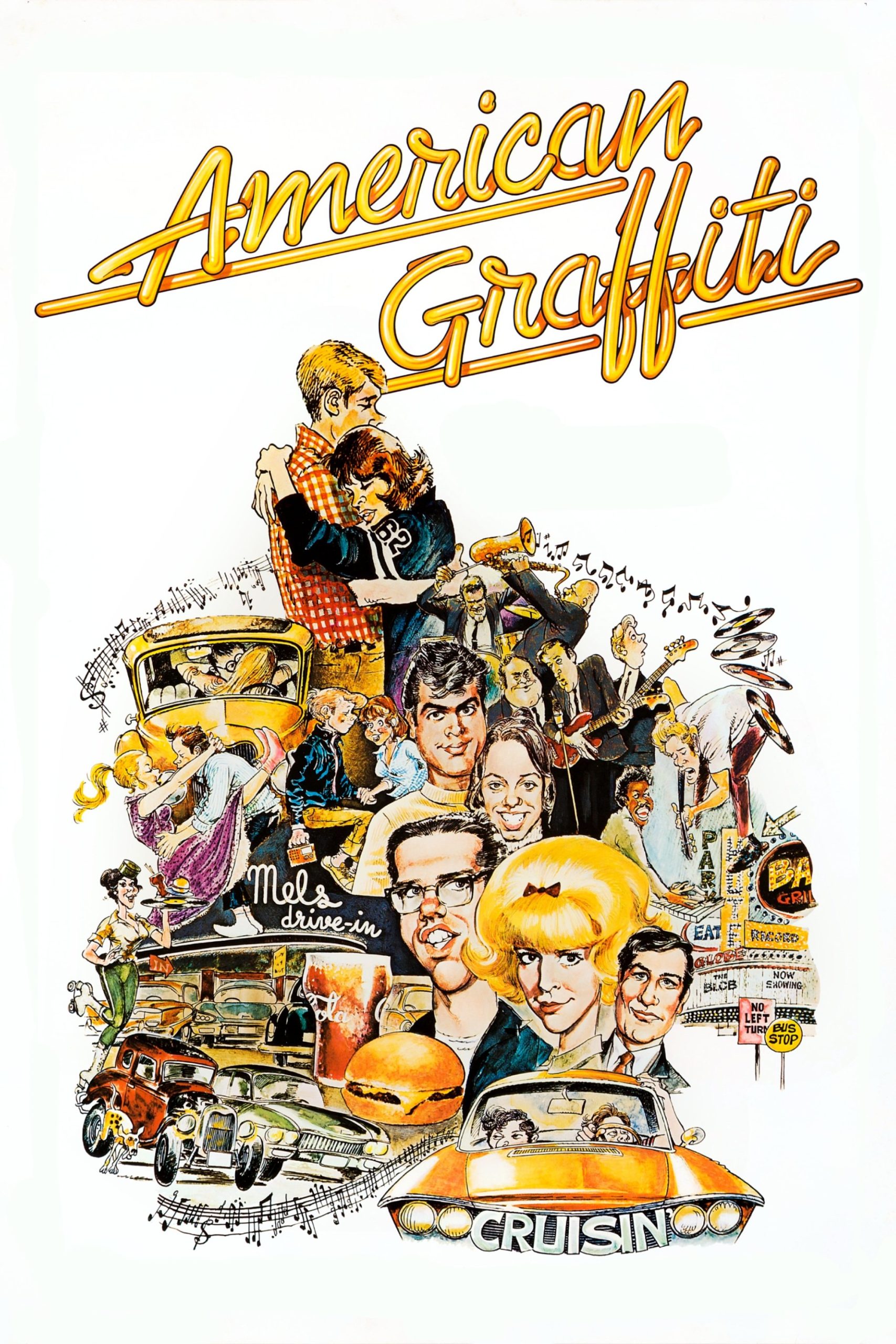
The Question of Truth Behind the Film
When I revisit “American Graffiti,” what always strikes me is how easily I slip into the belief that I’m watching a snapshot of real life. There’s something about the film’s seamless attention to period detail and the way it orbits small moments—slow drives, crackling radios, spontaneous conversations—that evokes the feeling of lived memory rather than scripted fiction. It’s fascinating how quickly I begin to wonder: Was this someone’s actual story? Did these kids really prowl the neon-lit streets of Modesto with the same sense of restless anticipation?
For me, that urge to distinguish fact from invention comes from my own curiosity about how stories are born. I notice that the “based on a true story” label always shifts my viewing experience. I’m more alert to the film’s choices, more tempted to quietly evaluate which parts unfolded as shown and which might be heightened, altered, or completely conjured. Even if a film doesn’t declare its factual origins, the intimacy and realism of a work like “American Graffiti” almost dares me to put on my detective’s hat and search for real-life analogs. I suppose when a film feels “true,” I become invested in the veracity of its events, eager to know whether I’m witnessing an echo of real adolescence or merely a well-crafted mirage.
There’s an assumption, too, that factual storytelling bonds me more closely to a film’s world. Whenever a movie lays claim to historical roots, I find myself approaching it with a certain reverence—sometimes granting its narrative decisions more weight purely because they might really have happened. Yet, I’m also aware that this reverence can come with skepticism. If a film veers too far into melodrama or neat resolution, I catch myself mentally questioning, “Could life really be so tidy, or is this Hollywood smoothing away the messiness?” Ultimately, the weight of the “true story” promise is heavy, and it’s something I bear as I watch, coloring both my personal engagement and my willingness to emotionally invest.
Historical Facts and Cinematic Interpretation
As I trace the contours of “American Graffiti,” I’m struck by how George Lucas harnesses his own recollections of early 1960s small-town California—stories of cruising, radio DJs, and teenage rites of passage—to ground the film’s authenticity. Yet, beneath the film’s surface realism, I can sense the scaffolding of cinematic construction. Lucas drew inspiration from his own adolescence in Modesto, but what emerges is not a direct retelling of specific events. Instead, I find a mosaic assembled from hundreds of small truths: the distinctive slang, fashions, soundtrack, and rituals that defined the era.
What I find fascinating is the creative reshaping that inevitably occurs in the translation from lived experience to screen. Fragmented memories are condensed into a single night; archetypal characters aggregate traits from many real people. For example, the mythic DJ Wolfman Jack, presented as an enigmatic, almost shamanic radio voice, is both a real cultural figure and a stylized amalgam. The film magnifies his influence to the point where he becomes a spiritual thread pulling together the narrative and the town’s scattered youth. In real life, the DJ’s presence might have been less tangible or magical, but for narrative clarity, his role swells. Scenes of romance, rebellion, and longing are selected not because they happened on one night to a single group of friends, but because they articulate the broader emotional landscapes of an age.
I see this process—reshaping and distilling reality—not as a slight-of-hand, but as the primary engine of cinematic storytelling. Packing multiple years, personalities, and vignettes into the tight span of a “last night of summer” enables Lucas to evoke the bittersweet crescendo of coming of age. This isn’t a journalistic chronicle. Instead, I witness a work that’s true to the emotional texture of its source rather than the literal facts. My attention is drawn less to the nuts and bolts of specific events and more to the mood and psychological truth they strive to communicate. The end product, therefore, blurs the boundary between recorded memory and creative interpretation, making me reconsider what “truth” actually looks like on film.
What Changes When Reality Is Shaped for Cinema
When I reflect on the transformation of lived experience into cinema, I’m acutely aware of the complex negotiation involved. In the case of “American Graffiti,” this negotiation reveals itself in the film’s rich yet tidy structure. There’s a tension I sense between the sprawling, disorderly quality of real adolescent nights and the needs of narrative cohesion. Condensing an entire cultural moment into a single evening, as Lucas does, is both an act of compression and a deliberate narrative strategy. That compression means some complexities—lingering relationships, longstanding feuds, quieter heartbreaks—are hinted at rather than fully explored.
What intrigues me is how the film’s careful selection and arrangement of events create an emotional logic that real life often lacks. Storytelling conventions demand closure, connection, and clarity—a marked contrast to the ambiguity of memory. When a character faces a life-changing decision at midnight and resolves it by dawn, I’m reminded that real-life dilemmas rarely resolve so quickly. Yet this narrative economy amplifies the emotional stakes, locating a universal resonance within a compressed window of time. The trade-off is inevitable: messy realities are streamlined for dramatic effect. Time is telescoped. Supporting players are melded together for simplicity. Even the film’s famously evocative soundtrack, which seems to play at every turn, is a heightened version of reality—no night likely sounded so continuously vibrant, but it captures the constant undercurrent of music in teenage life.
Through this process, something subtle but profound takes place. I find myself responding to the authenticity of feeling rather than the facticity of events. The condensation of experience doesn’t erase the core truths; if anything, it sharpens them. The emotional highs and lows are concentrated like a reduction sauce, producing scenes that might never have existed in precisely this form, but which ring true in their cumulative effect. This distillation means I’m not watching a documentary, but rather a curated vision—one that prizes resonance and mood over pure documentation. The price for cinematic clarity is paid in the currency of complexity and ambiguity, but the gain is an intensified, affecting experience.
Audience Expectations and the “True Story” Label
When I consider the impact of the “true story” label—or even the mere suggestion of biographical roots—I realize how deeply it colors my receptiveness to a film’s details. With “American Graffiti,” the sense that it springs from lived reality primes me to search for connections between the film and history: the accuracy of cars, the authenticity of slang, the fidelity to the social dynamics of the early ’60s. If someone had told me every event was carefully logged from a real diary, I’d feel a burden of assessment, measuring the film’s every move against some external standard of truth. When the label of pure fiction is attached, I allow more latitude for exaggeration, metaphor, or implausible coincidence. My response, in other words, is continually shaped by how a film positions itself along the fact-fiction continuum.
I find that a film explicitly advertised as factual leads me to approach its plot twists, emotional crescendos, and character arcs with a different level of scrutiny. I often wonder, “Would this person really have said that?” or “Did this dramatic incident actually occur?” When the label softens to “inspired by true events,” I grant the filmmakers more creative freedom—I accept amalgams, symbolic scenes, and speculative asides. With “American Graffiti,” which so effortlessly inhabits its era that it feels plucked from real nights, I’m left in a liminal space. I know the inspiration is autobiographical but filtered through artistic license, so I’m drawn to interpret the film’s choices through both lenses: fact and fiction. It’s almost as if the film asks me to participate in deciphering what’s “real,” drawing me into an implicit game of compare and contrast with my own recollections or cultural knowledge.
For many viewers I’ve spoken with, the “true story” implication deepens emotional engagement. There’s a special frisson in believing that what you see on the screen literally unfolded in the world outside the theater. On the other hand, when inaccuracies or embellishments come to light, there’s sometimes a sense of disappointment or even betrayal. I notice this tension is less acute in films that are openly fictional—even when, as in “American Graffiti,” the fiction is painted with undeniably personal hues. What fascinates me is how my baseline expectations about reality shift in response to marketing, paratextual materials, or behind-the-scenes interviews. The boundary between “real” and “invented” becomes less a wall and more a gradient, and my understanding of the film is filtered through the lens of that ambiguity.
Final Perspective on Fact vs Fiction
In the end, my engagement with “American Graffiti” is enriched, rather than diminished, by my awareness of its elaborate dance along the fact-fiction divide. Knowing which elements are rooted in George Lucas’s adolescent experience, and which are constructed or rearranged for dramatic effect, lets me appreciate the film not only as a historical artifact, but as an act of creative remembering. I find myself tracing the echoes of real memory and recognizing the places where invention steps in to heighten meaning. My interpretation becomes a layered process: I oscillate between seeking out historical Easter eggs and letting go, surrendering to the film’s own narrative rhythm and emotional logic.
There are moments, admittedly, when knowing the source material nudges me to read scenes differently. If I know a subplot is an authentic retelling from Lucas’s youth, its poignancy intensifies. If I discover an invented or composite scenario, I’m sometimes able to regard it more as a thesis about growing up than a straight account. The knowledge doesn’t lessen the film’s impact; if anything, it makes me more aware of the choices made in distilling memory into story. Each passage of the film—each lingering glance, wrenching farewell, or exultant drag race—acquires dimension as both homage and creative synthesis.
Ultimately, my perspective on “American Graffiti” is shaped by my willingness to move between the registers of fact and interpretation. I don’t approach it as a courtroom document of a vanished America, nor as pure escapist invention. Instead, I find value in its status as a fictionalized document—a cinematic version of a scrapbook, curated and reassembled, whose truth resides not in fidelity to event, but in resonance with experience. My understanding of the film is more nuanced, and perhaps more personal, for knowing how the boundaries of fact and fiction are navigated, stretched, and selectively blurred.
For additional context, you may also explore the film’s overview and how it was received by audiences and critics.
🎬 Check out today's best-selling movies on Amazon!
View Deals on Amazon